Gaming Master Guides Portal ยท France

Spinboss โ€“ Master Level Play

Welcome to the Mastery Forge, the dedicated portal where serious players transform raw reflexes into calculated dominance. The path to Spinboss mastery is not a grind of hours โ€” it is a deliberate journey of mindset, pattern recognition and decision architecture. Most players plateau because they play more; masters rise because they play differently. Here we strip the game down to its bones: positioning geometry, tempo control, resource economy and the silent language of pressure.

To master Spinboss you must first master yourself. Tilt is the true final boss, not the opponent. A master enters every match with a pre-loaded game plan, a calibrated risk threshold and an exit protocol for bad sessions. We treat each round as a data point, each loss as a diagnostic, each win as a confirmation of theory. The expert mindset is cold, curious and incremental โ€” you are never playing the moment, you are always playing the trajectory.

This portal is built for that trajectory. Ten expert tips rewire your fundamentals. Eight advanced combos give you executable kill sequences with measured impact. Four deep analyses break down the systems most players misunderstand. Five master-class concepts tie everything into a unified philosophy you can carry into any lobby. Read slow, drill one thing at a time, and the crown stops being a symbol and starts being a habit. Spinboss rewards the disciplined โ€” and the disciplined are made, not born.

10
Expert Tips
8
Combos
4
Deep Analyses
5
Master Concepts
Mastery In Play Spinboss mastery expert play โ€” a focused player executing advanced technique under competitive pressure
Section 02 ยท Fundamentals Rewired

10 Expert Tips for Spinboss Dominance

Ten pro-level tips covering positioning, timing, decision making and resource management โ€” each one a deliberate upgrade to a habit you already have.

01

Anchor Before You Engage

Before every fight, claim an anchor โ€” a wall, a corner, a height edge you can fall back to under pressure. Spinboss rounds are won by players who always have a retreat vector, not by those who commit fully. Anchoring turns chaos into a decision tree you control.

Positioning
02

Read The Tempo, Don't Force It

Every opponent broadcasts tempo through movement cadence and ability spacing. Slow your breathing, watch two full cycles, then match or invert their rhythm. Forcing your pace on a faster player telegraphs every intent and hands them the counter on a plate.

Timing
03

Decide In Pre-Commit, Not On Contact

Master players choose their action before the encounter, then execute on contact. On-contact deciding is reaction territory and costs 200ms you don't have. Pre-commit plans fold cleanly into backups, so when plan A breaks you're already running plan B without panic.

Decision Making
04

Treat Resources As Investment, Not Ammo

Cooldowns, charges and currency are investment capital, not a magazine to empty. Spend only when expected return beats hold value. A held cooldown is leverage; a wasted one is a debt you repay in the next fight you can't win because it wasn't ready.

Resource Management
05

Own The Diagonal, Not The Center

Center control is obvious and contested. Diagonal lanes offer identical sightlines with half the threat angles. Spinboss maps reward rotational geometry โ€” occupy diagonals to force opponents into predictable cross-lane rotations you can punish with timing.

Positioning
06

Frame-Count Your Recovery Windows

Every whiffed ability has a recovery frame window the opponent can punish. Learn the exact count for your three most-used moves. Once you feel frames instead of guessing them, your aggression becomes surgical โ€” you only swing into openings that actually exist.

Timing
07

Play The Scoreboard, Not The Fight

Decision quality must scale with round economy. When ahead, trade unfavorably for them โ€” force even swaps that shrink their options. When behind, refuse fair trades and hunt only asymmetric wins. The scoreboard is your strategist; the fight is just execution.

Decision Making
08

Bank Recovery Before You Need It

Recovery items and reset charges should be banked at 70% thresholds, not 10%. Late-banking means you survive the next hit but lose the next fight. Early banking builds a buffer that lets you play aggressively from a position of safety โ€” the master's signature.

Resource Management
09

Use Off-Angle Pressure Lanes

Direct pressure is expected and absorbed. Off-angle lanes โ€” a 22ยฐ offset from the obvious approach โ€” break the opponent's defensive framing and force repositioning. That reposition is a 400ms window where their return fire is inaccurate. Enter through it.

Positioning
10

Reset Between Rounds, Not Between Sessions

The 12 seconds between rounds are not idle time โ€” they're a reset ritual. Breathe out tension, recall one lesson from the previous round, set one intention for the next. This micro-routine prevents tilt creep and keeps your decision quality stable across long sets.

Decision Making
Section 03 ยท Executable Kill Sequences

Advanced Combos & Sequences

Eight advanced combos with names, descriptions, execution steps and measured impact. Drill them slowly, then chain them into your natural flow.

Vortex Crown

Tier S

A rotational opener that traps opponents in a closed-loop pressure cycle. You bait the defensive cooldown, pivot on the recovery frames, and chain three micro-hits while their escape is still on cooldown. Best used as a round-one opener to map their habits.

ExecutionBait โ†’ Pivot โ†’ 3ร— Micro-hit
Impact+38% round control

Phantom Lateral

Tier A

A side-step feint combo that punishes over-committed aggression. You mirror their approach vector, lateral-cancel at the last frame, and counter on the whiff punishment window. Builds psychological hesitation that compounds across the set.

ExecutionMirror โ†’ Lateral-cancel โ†’ Counter
Impact+27% whiff punish

Echo Surge

Tier S

A double-pulse burst that exploits the recovery gap between an opponent's first and second defensive read. Fire a low-commitment poke, hold 80ms, then surge the real damage while they re-anchor. The pause is the weapon โ€” it forces a re-decision.

ExecutionPoke โ†’ 80ms hold โ†’ Surge
Impact+44% burst conversion

Crownbreaker

Tier A

Designed to dismantle anchored defenders. You apply diagonal pressure to force a reposition, then intercept the re-anchor path with a frame-trap. Defenders who rely on a single safe corner collapse inside two cycles of this sequence.

ExecutionDiagonal press โ†’ Trap re-anchor
Impact+31% corner break

Null Cascade

Tier B

A defensive combo that converts a successful block into a tempo steal. Block โ†’ instant cancel โ†’ forward micro-dash โ†’ punish. It reframes defense as the start of offense and punishes opponents who treat their own pressure as safe.

ExecutionBlock โ†’ Cancel โ†’ Dash โ†’ Punish
Impact+22% tempo steal

Apex Helix

Tier S

A spiraling high-low mix that layers two threat axes simultaneously. You ascend with a high read while the low option loads in parallel, then commit based on their defensive tilt. Forces opponents to guess rather than react โ€” guessers lose to reactors.

ExecutionHigh read โ†’ Parallel low โ†’ Commit
Impact+49% mix success

Silent Wake

Tier A

A wakeup trap that punishes impatient opponents returning from knockdown. You hold a delayed pressure frame just outside their wakeup range, then strike the moment they commit to a get-up option. Patience is the damage multiplier here.

ExecutionHold range โ†’ Read get-up โ†’ Strike
Impact+34% wakeup punish

Eclipse Loop

Tier S

The crown closer โ€” a self-feeding loop that resets its own opener if the opponent fails to escape. You chain Vortex Crown into Echo Surge, and if both connect, re-enter Vortex. Closes games from a single clean read and breaks mental resolve fast.

ExecutionVortex โ†’ Echo โ†’ Re-enter Vortex
Impact+58% close-out rate
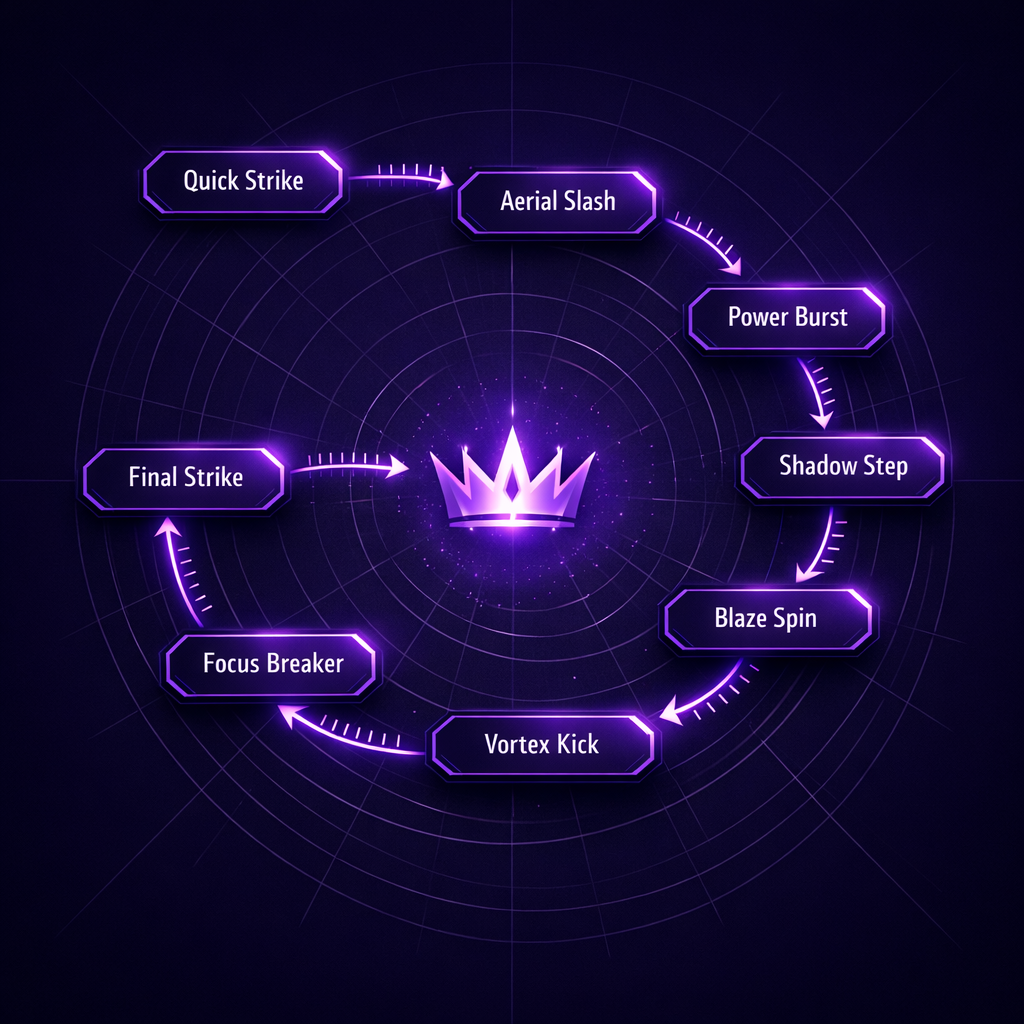
Spinboss combo diagram showing sequence flow with timing frames and execution arrows
Combo Sequence Map โ€” execution flow, frame windows and impact weights across the eight core sequences.
Section 04 ยท Systems Decoded

Deep Analysis of Core Systems

Four in-depth breakdowns of the systems most players feel but never name. Understanding the mechanism is the difference between using a tool and being used by it.

1 Pressure Geometry & Spatial Leverage

Pressure in Spinboss is not a feeling โ€” it is geometry. Every angle you occupy narrows the opponent's viable response set by a calculable margin. Two simultaneous angles reduce options exponentially, not additively. This is why solo aggression plateaus: a single pressure vector always has a counter, but intersecting vectors create decision paralysis. The master's job is to convert space into leverage before the first shot, so the fight is half-won by geometry alone.

Conclusion: Win the map before the duel. Pressure is a spatial asset, not an emotional one โ€” measure it in angles occupied, not in damage dealt.

2 Tempo Cycles & The Recovery Economy

Tempo is the currency of when, and recovery frames are its interest rate. Every committed action borrows tempo against your next available action. Players who spend tempo on low-value actions go bankrupt in the late round. Masters run a positive tempo balance: they take small, cheap actions that keep their next option open, and only spend big when the opponent is in recovery debt. Reading the opponent's tempo balance tells you when to press and when to wait.

Conclusion: Treat recovery as debt. Press when the opponent is over-leveraged, hold when you are โ€” tempo discipline beats raw speed every time.

3 Information Asymmetry & The Read Game

Every round is an information market. You reveal your habits through patterns; the opponent reveals theirs. The player with more reliable reads has a structural edge that compounds across the set. Masters deliberately leak false patterns early to manipulate the market, then cash in the false read mid-set for a decisive conversion. The read game is why two equally mechanical players can have vastly different win rates โ€” the one with better information hygiene wins.

Conclusion: Manage what you reveal as carefully as what you observe. Information is a tradable asset โ€” leak deliberately, read aggressively.

4 Resource Economy & Multi-Fight Compound Interest

Resources in Spinboss compound across fights, not within them. A cooldown spent efficiently in fight one is available as leverage in fight three. Players who optimize per-fight often lose the set, because they spend tomorrow's advantage today. The master frames every resource as a multi-fight investment: hold when the immediate return is marginal, spend when the compounded return across the remaining fights is maximal. This is the slow edge that wins long sets.

Conclusion: Play the set, not the fight. Resource efficiency compounds โ€” the player who treats cooldowns as capital outlasts the player who treats them as ammo.

Section 05 ยท The Unified Philosophy

Master Class: 5 Concepts That Tie It Together

Five master-level concepts that unify tips, combos and analysis into a single portable philosophy you can carry into any lobby.

๐Ÿงญ

Pre-Loaded Intent

A master never enters a moment without a pre-loaded intent. Intent is the decision you made before the situation arrived โ€” it converts reaction into execution. Without it, you improvise; with it, you perform. Pre-loading intent is the single highest-leverage habit in the entire mastery stack, because it removes the slowest variable in human performance: on-contact deliberation.

Examples: round opener pre-decided ยท escape vector pre-mapped ยท fallback combo pre-selected
โš–๏ธ

Asymmetric Trading

Never accept a fair trade when an asymmetric one is available. Masters engineer trades where their cost is small and the opponent's cost is structural โ€” a cooldown, a positional anchor, a tempo debt. Fair trades are for evenly matched players; asymmetric trades are how masters convert small edges into set-winning cascades over ten rounds of play.

Examples: small poke for big cooldown ยท corner loss for tempo gain ยท chip for resource drain
๐ŸŒ€

Loop Discipline

When a sequence works, the temptation is to abandon it for novelty. Loop discipline is the restraint to re-enter a winning loop until the opponent proves they can escape it. Most opponents never adapt inside a single set โ€” the master collects the free wins instead of chasing the stylish ones. Boring loops win tournaments; flashy novelties win highlights.

examples: Eclipse Loop re-entry ยท Silent Wake repeat ยท Vortex until broken
๐Ÿ”‹

Energy Budgeting

Focus is a finite resource with a daily budget. Masters spend it on review, drilling and the first rounds of a session โ€” not on warm-up auto-pilot or tilt-queueing. A session played underfunded is worse than a session skipped. Budgeting attention is the meta-skill above all tactical skills: it determines whether the rest of the stack even gets used.

Examples: review before queue ยท drill before play ยท stop-loss on tilt
๐Ÿ‘๏ธ

The Diagnostic Eye

Every loss is a diagnostic, every win a confirmation. The diagnostic eye reframes outcomes as data rather than verdicts, which defuses tilt and accelerates learning. After each session, name one mechanical fault and one decision fault โ€” nothing more. Compounded over weeks, this micro-debrief builds the pattern library that separates masters from grinders.

Examples: name one fault per session ยท tag losses by type ยท rewatch only losses